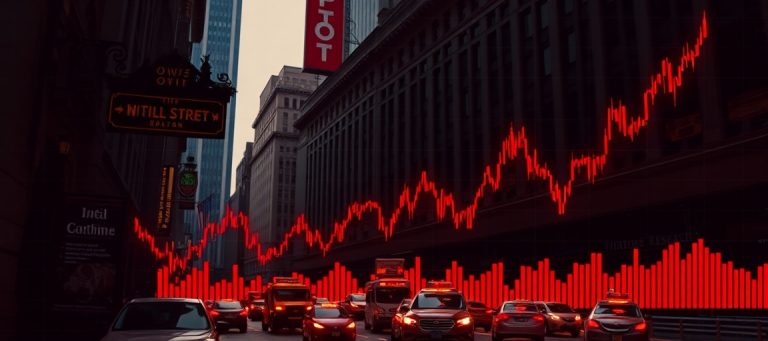
Summer 2026 is shaping up to be one of the most complex periods for U.S. monetary policy since the 2008 crisis. With Bitcoin trading around $62,636 on July 9, a scenario once considered marginal began making its way through trading floors and dealing desks: what if the Federal Reserve, unable to cut interest rates due to inflation fueled by the artificial intelligence boom, were forced to backstop the equity market through indirect interventions? Such a shift could paradoxically provide fertile ground for a renaissance of the cryptocurrency market, currently mired in a historic “Extreme Fear” phase with the Fear & Greed index falling to 22.
The AI Paradox: Driver of Growth, but Also of Persistent Inflation
Over the past eighteen months, generative artificial intelligence has been the primary catalyst for the rise in U.S. equity markets. The tech giants — the famous “Magnificent Seven” — have invested hundreds of billions of dollars in acquiring GPUs, building oversized data centers, and massively recruiting researchers and engineers. This AI gold rush has created outsized demand for energy resources, cooling equipment, and electrical infrastructure, generating inflationary pressures in sectors that previously seemed immune to rising prices.
This phenomenon, which some analysts call “innovation-driven inflation,” has a particularly troublesome characteristic for the Fed: unlike classic demand-pull inflation, it does not respond mechanically to higher interest rates. When Nvidia, Microsoft, or Amazon place $50 billion orders for infrastructure, they do so with five-to-ten-year investment horizons, perfectly indifferent to whether the Fed Funds rate moves from 5.25% to 5.50%. AI-related investment decisions are structural, not cyclical. They stem from a deep conviction that competitive advantage is now determined by access to computing power, regardless of the cost of capital.
This dynamic has directly contributed to keeping core inflation at a higher level than initial forecasts. Core CPI indices are struggling to fall below the 3% threshold, while the PCE — the Fed’s preferred indicator — stubbornly remains above the 2% target. Every macroeconomic data release in the spring and early summer of 2026 brought a fresh set of unpleasant surprises, pushing the horizon for a first rate cut further into the distance.
The Fed’s Trap: Neither Hike Nor Cut
Jerome Powell and the Federal Open Market Committee have found themselves in an untenable position. On one hand, cutting rates in an environment where inflation remains sticky would send a disastrous signal to bond markets and risk unanchoring inflation expectations. On the other hand, maintaining restrictive rates while the economy shows clear signs of slowing — especially in manufacturing and commercial real estate — exposes the Fed to the risk of triggering an avoidable recession.
It is in this context that the thesis of an “implicit backstop” for equities by the Fed has resurfaced. The idea, circulating on New York trading desks and in certain research notes, goes as follows: if the equity market were to correct sharply under the combined weight of high rates and stretched tech valuations, the Fed could intervene not by cutting rates — politically and economically impossible in the current inflationary environment — but through more discreet mechanisms. Among the tools mentioned: expanded repo operations, an easing of liquidity conditions via the discount window, or a deliberate slowdown in the pace of balance sheet reduction (the well-known quantitative tightening).
Some strategists go further, raising the possibility of a coordinated intervention with the U.S. Treasury, similar to what was done in March 2023 during the regional banking crisis, but this time directed at supporting capital markets rather than the banking system. The central argument is that the weight of tech in U.S. stock indices — the S&P 500 has never been so concentrated in technology stocks — makes the entire financial system vulnerable to a brutal correction in the AI sector.
The Transmission Channel to Cryptocurrencies
How could an implicit backstop of the U.S. equity market benefit the cryptocurrency market, even as Bitcoin experiences one of its deepest “Extreme Fear” phases? The answer lies in the mechanics of market correlations and the psychology of institutional investors.
Since 2023, the correlation between Bitcoin and the Nasdaq 100 has significantly strengthened. Both assets share a common sensitivity to global liquidity conditions and risk appetite. A Fed backstop that stabilizes the Nasdaq would send a powerful signal to investors: liquidity is not drying up, systemic risk is contained. In this scenario, risky assets as a whole — including cryptocurrencies — benefit from a “rising tide” that lifts all boats.
But there is a more specific angle. If the Fed intervenes by injecting liquidity through its market operations, some of that additional liquidity traditionally finds its way into alternative assets. Bitcoin, often described as “digital gold” but behaving in practice as a high-beta risk asset, could be one of the main beneficiaries of such a dynamic. Analysts who advocate this thesis recall that the two previous Bitcoin bull cycles — 2017 and 2021 — coincided with periods of quantitative easing or the maintenance of very accommodative monetary conditions.
Geopolitical Context: Iran and Oil Harden the Equation
The analysis would not be complete without integrating the geopolitical dimension. On July 9, 2026, with Bitcoin trading at $62,636 and Ethereum at $1,748, crude oil stood at $75 per barrel, supported by persistent tensions surrounding Iran. The Iranian ceasefire, which had brought a brief respite to energy markets, had just collapsed,...
Analyse détaillée réservée aux membres
Notre équipe d'analystes a préparé une analyse complète avec données exclusives.
🔒 Paiement sécurisé • Stripe • Sans engagement
Déjà abonné ? Connectez-vous