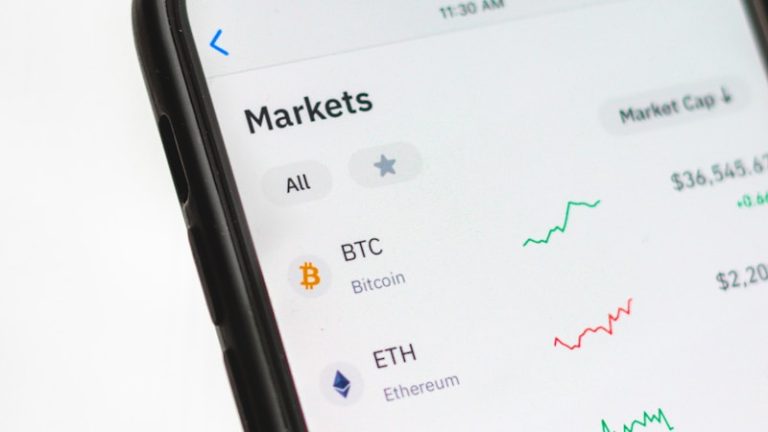
Bitcoin has just broken through $65,400, its highest level in a month, after a week of consolidation around the $64,000 mark. This rebound revives hopes of a return to bullish momentum, as the options market records massive positions targeting $72,000 by the end of the month — a date that precisely coincides with the next Federal Open Market Committee (FOMC) meeting.
The king of cryptocurrencies is rallying against a particularly packed macroeconomic backdrop: the European Central Bank (ECB) is set to announce its rate decision this week, discussions around the Clarity Act are stalling in the U.S. Senate, and equity markets are showing signs of sectoral fragility, especially in tech and AI. All these factors could dictate Bitcoin’s trajectory in the days ahead, especially given that the correlation between BTC and traditional equity indices remains historically high.
🔍 Bitcoin’s Breakout: What Happened?
After oscillating between $62,500 and $64,000 for nearly ten days, Bitcoin finally found a catalyst to break out of its range. Several factors explain this sudden acceleration, which caught many short-positioned traders off guard.
Trading volume surged nearly 40% on major platforms (Binance, Coinbase, Kraken) at the moment of the $65,000 breakout, confirming the move’s legitimacy. Short position liquidations also contributed to the bullish acceleration, with over $120 million in shorts liquidated in 24 hours across the entire crypto derivatives market.
1. Oil Stabilization and Easing Geopolitical Tensions
Last week, the oil surge — hitting its monthly high — weighed on Bitcoin and all risk assets. Fears of an escalation in the Middle East and tensions between the United States and Iran sent shockwaves through markets. However, these tensions appear to have eased over the past 48 hours, allowing oil to stabilize and risk assets to regain ground.
The historical correlation between Bitcoin and crude oil has once again been confirmed: when black gold rises in a tense geopolitical context, BTC corrects. Conversely, a détente on the oil front releases pressure on crypto markets. This relationship is explained by oil’s impact on anticipated inflation and, consequently, on central bank monetary policy.
2. Tech and AI Stocks Rebound
The technology sector, which was undergoing a violent correction triggered by the performance of Chinese chatbot Kimi K3 (Kimi AI) — surpassing Claude and GPT in coding benchmarks — is beginning to show signs of stabilization. AI stocks like Hut 8 and IREN have raked in billions of dollars in new contracts, restoring investor confidence. The Nasdaq, which had fallen sharply, has trimmed its losses, and this rebalancing has benefited Bitcoin.
The BTC/Nasdaq correlation remains high, around 0.65 over a 30-day rolling period. When tech breathes, Bitcoin breathes too. This link is explained by the similar risk profile of both assets: both are sensitive to the same macroeconomic factors (interest rates, risk appetite, global liquidity) and often attract a common investor base.
3. Bitcoin ETFs Recover Some Color
After weeks of net outflows — described by some analysts as an “exodus” — U.S. spot Bitcoin ETFs are seeing capital inflows again. Although the flows remain “modest” compared to previous outflows, the mere fact that the trend is reversing is psychologically important for the market. Over the past week, spot Bitcoin ETFs recorded approximately $368 million in net inflows over three days, according to data compiled by Bloomberg.
This reversal suggests that institutional investors are gradually returning to the market, even if the volume is not yet comparable to that seen during the Q1 2026 rally. The fact that this flow recovery coincides with the bullish breakout is an encouraging signal for the sustainability of the move.
📊 Bitcoin Options Bet on $72,000 — and the Fed as Referee
One of the most intriguing signals in recent days comes from the Bitcoin options market. Massive call spreads have been opened, targeting a price of $72,000 for the end of July. The particularity of these positions is that they expire just after the FOMC meeting on July 29-30, 2026.
This type of positioning is not trivial. “Smart money” — those sophisticated traders operating in the options market — are apparently anticipating a Fed decision that could act as a bullish catalyst for Bitcoin. The amount at stake is significant: several hundred million dollars in notional value are concentrated at this strike level, creating a “gamma wall” that could itself attract the price toward that zone.
The mechanism is well known to options traders: the greater the concentration of open interest at a given level, the more market makers are incentivized to hedge their positions, which creates a magnetic pull toward that level as expiration approaches. The $72,000 level for end of July is therefore much more than a simple speculative bet: it is a level that could become a self-fulfilling prophecy.
Why $72,000 Is a Credible Target
- Resistance broken: The move above $65,000 opens the way toward the $68,000-$70,000 zone, the next major resistance identified by technical analysis.
- Moving averages: BTC has reclaimed its 50-day moving average (currently at $63,800), a short-to-medium-term bullish technical signal.
- Volume: The increase in trading volumes accompanying this breakout suggests real momentum, not a simple “fakeout” designed to trap traders.
- RSI: The Relative Strength Index (RSI) sits around 55-58, in neutral territory — not yet overbought, leaving room for a significant upside extension before reaching overbought levels (RSI > 70).
- Open interest: Open interest on $72,000 call options for end of July has increased by over 150% in one week, according to Deribit.
🏛️ The Busiest Macro Week of the Month
This week’s economic calendar is particularly dense and could directly impact Bitcoin’s trajectory. Investors are watching three major events that unfold over just a few days.
Thursday, July 23 – ECB Rate Decision
The European Central Bank will announce its monetary policy decision this week. The market anticipates a status quo (rates held at 3.25%), but any surprise — especially a dovish or hawkish tone in Christine Lagarde’s communication — could have repercussions on the U.S. dollar and, by extension, on Bitcoin.
A stronger euro against the dollar (if the ECB is hawkish) would weaken the DXY, which is historically positive for Bitcoin. Conversely, a dovish ECB would strengthen the dollar and weigh on BTC. The effect is indirect but very real: Bitcoin has shown a negative correlation of -0.4 with the DXY over the past year.
U.S. GDP and Inflation Data
This week, several U.S. economic releases will be scrutinized: the first estimate of Q2 GDP, durable goods orders, and the PCE index (the Fed’s preferred inflation indicator). Weaker-than-expected growth, combined with still-declining inflation, would strengthen the case for a rate cut in September — a powerful bullish catalyst for Bitcoin and all risk assets.
End of July – FOMC Meeting (July 29-30)
The next Fed meeting (July 29-30) is the most anticipated event of the month. After the status quo at the June meeting (rates held at 4.25-4.50%), markets are parsing every clue about the future rate path. Recent inflation data (CPI) is encouraging: core inflation continues to slow, reinforcing the scenario of a rate cut in September.
If the Fed’s July statement prepares the ground for a September cut — especially by modifying its forward guidance — Bitcoin could receive a powerful bullish catalyst. The $72,000 options for end of July suggest that some traders are precisely anticipating this scenario: an accommodative signal from the Fed propelling BTC to new highs even before the actual rate cut takes place.
⚖️ The Clarity Act: A Regulatory Silver Lining on Hold
On the U.S. regulatory front, the Clarity Act — a major piece of legislation aimed at clarifying the legal status of cryptocurrencies and defining the respective roles of the CFTC and SEC — remains stuck in the Senate. Polymarket traders have even reduced their probability of passage to a historic low, as delays drag on at the Capitol. This bill, considered crucial for institutional adoption, seems to be stalling in the labyrinth of the U.S. legislative process.
Yet, despite this blockage, the market appears to have priced in regulatory uncertainty as a neutral factor in the short term. Attention is more focused on macroeconomics and ETF flows than on legislative developments. This resilience is itself a positive signal: it suggests that the crypto market is beginning to “price” the Clarity Act not as an absolute necessity, but as a long-term bonus.
Over the longer term, adoption (even if delayed) of the Clarity Act would represent a major catalyst for the entire crypto sector, providing a clear regulatory framework for companies and institutional investors. Recent statements by the CFTC and SEC suggest both regulators are favorable to the bill, but partisan divisions in the Senate are slowing its review.
🌍 Institutional Adoption: Positive Signals Multiply
Beyond price action, several recent developments testify to the growing adoption of cryptocurrencies by traditional players:
Citadel Securities injected $400 million into...
Analyse détaillée réservée aux membres
Notre équipe d'analystes a préparé une analyse complète avec données exclusives.
9.9€ /mois✅ Accès 88 analyses Starter ✅ Newsletter quotidienne ✅ Annulation à tout moment🔒 Paiement sécurisé • Stripe • Sans engagement
Déjà abonné ? Connectez-vous